News (198)

Would you like to receive news from the SPIN Institute? This email address is being protected from spambots. You need JavaScript enabled to view it. to subscribe!

Decoupling Electron and Phonon Transport - A New Strategy for Thermoelectric Materials

A study published in the Journal of the American Chemical Society, involving Michele Reticcioli and Alessandro Stroppa from CNR-SPIN, L’Aquila, in collaboration with researchers at the University of Science and Technology Beijing, identifies a –promising strategy for designing materials that combine efficient electrical transport with weak heat conduction through the crystal lattice.

Read more...

Room Temperature Reconfigurable Ferroelectric 2D-Electron Gas (2DEG)

Reconfigurable two-dimensional electron gases (2DEGs) offer a powerful platform for controlling electronic conduction at interfaces, enabling conducting pathways to be formed, modified, and removed on demand. This functionality is highly attractive for nonvolatile, low-power electronics, while achieving such reconfigurability at room temperature remains a significant challenge.

Read more...

Quantum materials: discovery of the MISOH effect driven by multipolar structures

An international research team bringing together leading groups in the field of quantum materials, and guided by the SPIN Institute (Mario Cuoco and Luciano Jacopo D’Onofrio), in close collaboration with the teams from the University of Padova (Federico Mazzola), University of Krakow (Wojciech Brzezicki) and University of Salerno (Carmine Ortix and Maria Teresa Mercaldo), has uncovered a remarkable new phenomenon, now termed the MISOH Effect — Multipolar-Induced Spin-Optical Helicity effect.

Read more...

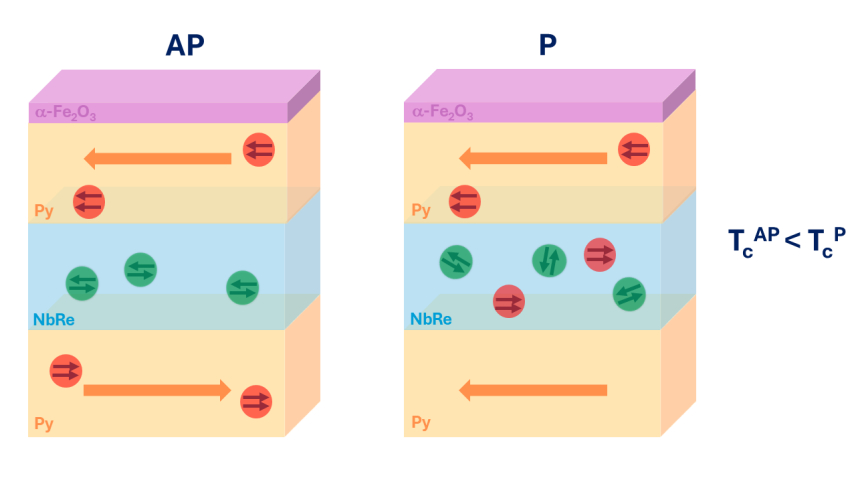
Spin-triplet Superconductivity Unveiled in NbRe-Based Spin Valves

A superconducting spin valve (SSV) is a device typically having a ferromagnet/superconductor/ferromagnet (F/S/F) sandwich structure. It can switch between a resistive and a dissipationless state upon the application of a small in-plane magnetic field, which allows the relative orientation of the F-layer magnetizations to change from parallel to antiparallel, respectively. 

Read more...
Subscribe to this RSS feed

SPIN belongs to
Cnr - Department of Physical Sciences
and Technologies of Matter