


SPARK-e is a new project funded by the European Innovation Council (EIC) with a total budget of almost €4 million. This collaborative consortium, made up of 10 partners from seven different countries, will design and test a new generation of phase change materials (PCMs) to boost the performance and extend the lifetime of smart edge devices.
Over the next four years, SPARK-e will design a technology free of critical raw materials (CRMs) to lead the European Union's goal of reducing energy consumption and improving heat dissipation – one of today’s most pressing challenges in electronics.
Energy consumption, a global issue
On our day-to-day basis, we hold highly sophisticated, complex and powerful devices in our hands, such as smartphones, tablets and laptops. As technology advances, these devices become even more complex, carrying out complicated calculations and processes. But everything has its limits. When we subject our electronics to excessive use or run resource-intensive programmes and apps, one consequence is heat generation, as certain components, such as the battery, transform electrical energy into thermal energy.
This heat, if not dissipated properly, may compromise the efficiency of the device, sometimes creating irreversibly damage. Such problem is not just a technological one as the device is also forced to increase its power consumption to maintain optimal performance. We must also consider that while the excess heat and increased energy use of a single mobile device may not seem like a major issue, with billions of phones, laptops, TVs and data centres in use worldwide, the cumulative impact is enormous.
SPARK-e is a project focused on a specific goal: designing materials capable of dissipating excess heat from electronic devices and, in addition, storing that heat to transform it into electricity paving the way for a new era in energy management. To this end, the team will explore the possibilities offered by PCMs as they are very promising materials that can store or release energy when subject to temperature changes, altering their crystalline structure. SPARK-e will go further from only thermal management solutions, with phononics at the heart of the project, focused on controlling heat flow and vibrations at the nanoscale.
Currently, when PCMs are considered for thermal management, the focus is mostly on solid–liquid systems. However, their use has certain limitations, such as changes in the material’s volume. SPARK-e will focus on solid-solid PCMs, a new alternative that is gaining ground. They undergo negligible volume changes, their manufacture involves less pollution, and, in addition, they have a longer useful life. Importantly, in SPARK-e, these materials will be designed without relying on CRMs. This approach aims to reduce dependence on scarce components and open the way to sustainable, environmentally responsible PCMs solutions suitable for thermal management in electronics.
The multidisciplinary SPARK-e team, made up of industrial partners, researchers and SMEs, aims to be a pioneer in the exploration of CRM-free solid-state PCM materials. To this end, over the next four years they will manufacture and test the efficiency of three different types of materials. The project, which ends in 2029, is expected to reach TRL-4 (Technology Readiness Level), which represents proof of concept for this technology.
“SPARK-e is a European initiative exploring new solid–solid phase-change materials to address one of the major challenges in nanoelectronics: how to better manage the heat generated by devices. The consortium, made up of 10 partners, brings together highly complementary profiles: a combination of scientific ambition, diverse capabilities, and a deeply collaborative way of working is what keeps the project coherent and cohesive,” says Claudia Gómez Aguirre, coordinator of the project and a researcher at the Iberian Centre for Research in Energy Storage (CIIAE) in Extremadura, Spain.
SPARK-e is led by the CIIAE and counts with the participation of:
- Chip Integration Technology Center (Netherlands)
- Loughborough University (United Kingdom)
- Consiglio Nazionale delle Ricerche (Italy)
- Heriot-Watt University (United Kingdom)
- International Iberian Nanotechnology Laboratory (Portugal)
- Halmstad University (Sweden)
- Amepox Microelektronics Co. Ltd (Poland)
- Ductolux, S.L (Spain)
- Agata Comunicación Científica SL (Spain)
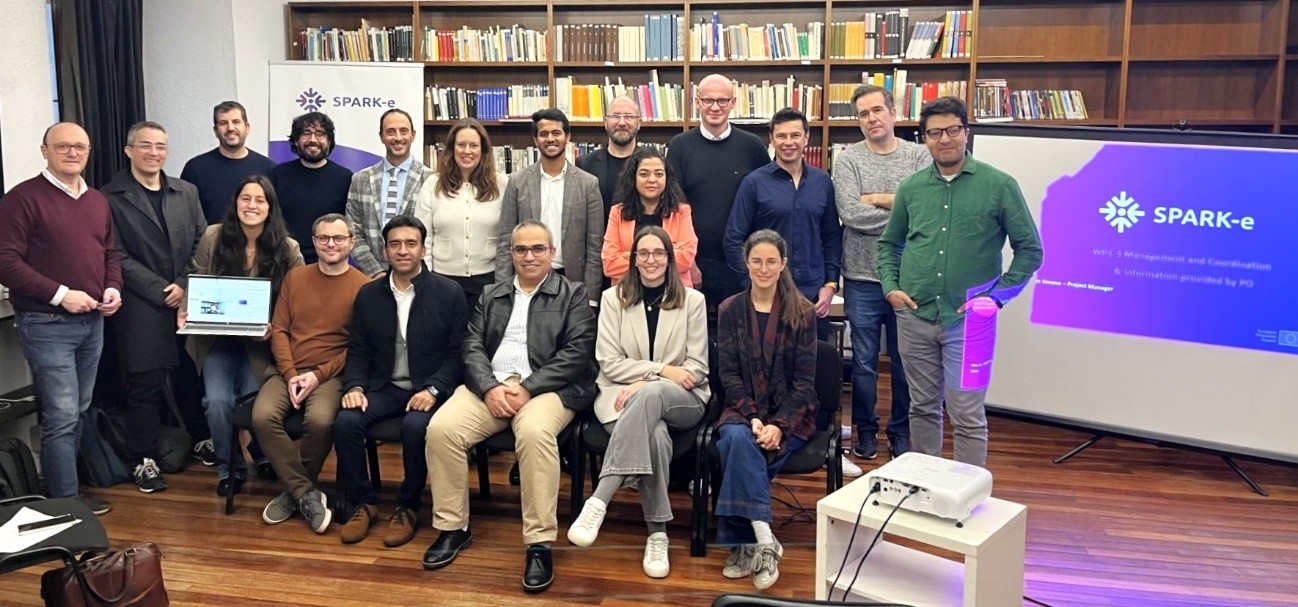
The SPARK-e team gathered for their kick-off meeting in Extremadura (Spain).
As part of the consortium, the CNR-SPIN (Italy) plays a central role as the theoretical Work Package partner, providing advanced ab-initio modelling under the leadership of Dr. Alessandro Stroppa.
Contact:
SPARK-e Press Office
Fernando Gomollón-Bel and Lucía Casas Piñeiro
This email address is being protected from spambots. You need JavaScript enabled to view it.

Funded by the European Union. Views and opinions expressed are however those of the author(s) only and do not necessarily reflect those of the European Union or the European Innovation Council and SMEs Executive Agency (EISMEA). Neither the European Union nor the granting authority can be held responsible for them.
